Uncategorized
Mistral Large 4: What “Le Chonk” Means for Developers and AI Teams
A practical, source-aware guide to Mistral Large 4, also known as Le Chonk: its 1.05T-parameter MoE design, 1M context window, multimodal and agentic capabilities, preview API, open-weight roadmap, and production trade-offs.

Mistral Large 4, “Le Chonk”: A Practical Guide to the New Open-Weight Model
Short answer: Mistral Large 4 is Mistral AI’s new general-purpose multimodal model, released in public preview on October 6, 2026. Mistral’s launch post calls it “le Chonk,” a playful name for a model with roughly one trillion parameters. The current model card lists 1.05T total parameters, 52B active parameters, a 1.6B vision encoder, and a 1M-token context window. You can test the hosted preview now; Mistral says the model weights will arrive by the end of October.
That combination makes Mistral Large 4 interesting for more than leaderboard watching. It is designed for long documents, images, coding, agentic tool use, scientific work, and enterprise workflows where teams care about control over deployment. It is also still a preview. The right question is not “Is Le Chonk the best model for everything?” The better question is: which workloads benefit from its long context, visual grounding, and open-weight roadmap enough to justify evaluation?
This guide explains the model in plain language, separates published facts from vendor-reported results, and gives developers a sensible path from first prompt to production test.
Table of contents
- What does Le Chonk mean?
- Mistral Large 4 at a glance
- Why the model is so large without activating everything
- The 1M context window: useful, not magical
- Multimodal understanding and visual grounding
- Coding, reasoning, and agentic workflows
- How to try Mistral Large 4 today
- Preview pricing and open-weight timing
- Where Le Chonk fits in a real stack
- Production checklist
- Mistral Large 4 FAQ
What does Le Chonk mean?
“Le Chonk” is Mistral’s official playful nickname for Mistral Large 4. It fits the company’s cat-themed identity and signals the model’s scale, but it is not a separate model family or a special lightweight mode. In code and documentation, look for the Mistral Large 4 model name and the currently documented API identifier, rather than treating “Le Chonk” as an endpoint name.
The nickname is useful because it captures a real architectural idea: this is a large model that uses sparse activation. Its total parameter count is enormous, but each token does not need to route through every expert. That distinction matters for teams thinking about inference cost, memory, latency, and eventual self-hosting.
It also matters for search and product language. People may ask for “Mistral Large 4,” “ML4,” or “Le Chonk” and mean the same public-preview model. A good implementation should use the exact model ID accepted by the provider and keep that mapping in configuration, not in scattered application code.
Mistral Large 4 at a glance
The following snapshot is based on the current Mistral model card and launch announcement. Preview figures can change, so treat the provider documentation as the operational source of truth.
| Item | Current public information | Why it matters |
|---|---|---|
| Model | Mistral Large 4, also called ML4 or Le Chonk | The name to use when searching documentation and examples |
| Availability | Public Preview | Expect changing limits, pricing, behavior, and documentation |
| Total parameters | 1.05T on the model card; the launch post rounds this to 1T | Describes total model capacity, not per-token compute |
| Active parameters | 52B | Sparse routing can use only part of the full model for each token |
| Vision encoder | 1.6B | Native image understanding rather than text-only prompting |
| Context | 1M tokens | Useful for large repositories, document sets, and long timelines |
| Capabilities | Chat, structured outputs, function calling, Document QnA, batch, agents, and built-in tools | Makes the model relevant to application workflows, not just chat |
| Open weights | Mistral says weights will be released by the end of October | Self-deployment is a roadmap item, not the same as today’s hosted preview |
Mistral’s launch material also reports strong results in coding, cybersecurity, agentic tasks, finance, legal work, science, and visual grounding. Those are vendor-reported evaluations. They are useful signals, but your own representative tests should decide whether the model is reliable for your data, latency target, and risk profile.
Why the model is so large without activating everything
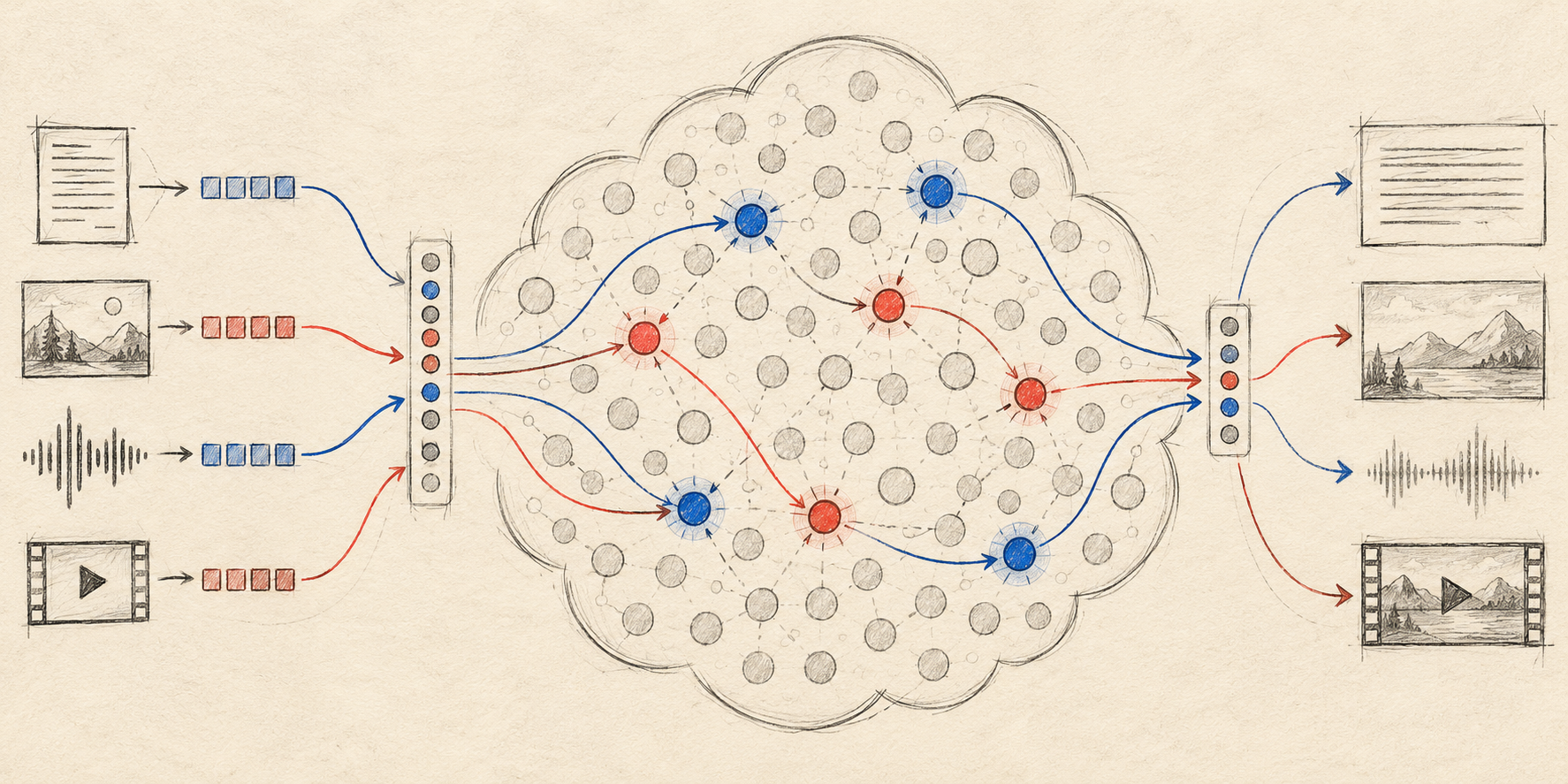
Mistral Large 4 uses a granular Mixture-of-Experts, or MoE, architecture. A dense model sends every token through the same full stack of parameters. An MoE model contains many expert pathways and a router that selects a smaller subset for each token. The total number of parameters describes the model’s capacity; the active count gives a better intuition for the computation used for an individual token.
This does not make deployment “easy.” A sparse model may still need substantial memory to hold its experts, and routing can create communication and scheduling challenges across accelerators. But it changes the engineering conversation. The model can be very capable without requiring every expert to perform work on every token.
For developers, the practical lesson is simple: do not infer latency, cost, or hardware requirements from the 1.05T number alone. Measure the hosted API first. If you plan to run weights yourself, wait for the release package, license, quantization options, recommended hardware, and serving guidance. Those details determine the real deployment shape.
The architecture also suggests why different prompts may exercise different strengths. A coding task, a document question, and an image-grounding task can activate different internal routes. That is not a guarantee of quality, but it is a reason to evaluate by workload rather than using a single generic prompt.
The 1M context window: useful, not magical
The headline 1M-token context window is one of the most attractive parts of Mistral Large 4. It can make workflows that normally require retrieval, chunking, and many intermediate summaries easier to prototype. Examples include:
- reviewing a large codebase with its tests, configuration, and incident history;
- comparing a set of contracts, financial reports, or technical manuals;
- tracing a long support case across messages, logs, screenshots, and decisions;
- asking questions over multiple related documents while preserving local context;
- keeping a long agent trajectory available for audit and handoff.
However, a large context limit is not the same as perfect recall. More input can increase noise, hide the most important evidence, and make evaluation harder. It can also increase time and cost. A useful long-context workflow still needs document selection, source identifiers, clear section boundaries, and a test for whether the answer cited the right evidence.
Think of the context window as working memory capacity, not a guarantee that every detail receives equal attention. For production systems, compare at least three strategies: a carefully retrieved short context, a larger assembled context, and a two-pass workflow that first finds evidence and then reasons over the selected excerpts.

Multimodal understanding and visual grounding
Mistral Large 4 is natively multimodal. It can reason over text and images together, which is valuable when the evidence is visual: a chart, a screenshot, a scanned page, a map, a product photo, or an engineering drawing. The model card lists a 1.6B vision encoder, while the launch material emphasizes document, chart, natural-image, and technical-image understanding.
The high-value use case is not “ask the model to describe a random picture.” It is to connect visual evidence to an operational question:
- Provide a clear image or document page.
- Ask the model to identify the relevant region or object.
- Require a concise answer tied to visible evidence.
- Return uncertainty when the image is blurry, incomplete, or ambiguous.
- Route high-impact decisions to human review.
For example, an engineering assistant could inspect a drawing, identify a component, compare it with a specification, and produce a list of discrepancies. A finance workflow could extract values from a chart and then show the source crop beside the answer. A support tool could classify a screenshot while preserving the original image for an agent to verify.
Visual grounding is still an evaluation problem. Test small text, dense layouts, rotated pages, charts with similar colors, and images where the correct answer is a tiny region. Use image URLs or upload methods supported by the current provider, set size limits in your own service, and never assume that a fluent description proves the model saw the right detail.

Coding, reasoning, and agentic workflows
Mistral positions ML4 as a general-purpose model with strong coding and agentic behavior. The announcement reports results on repository understanding, terminal workflows, automation tasks, spreadsheets, legal work, finance, mathematics, and physics. It also describes adjustable reasoning and tool-use features in the broader Mistral documentation.
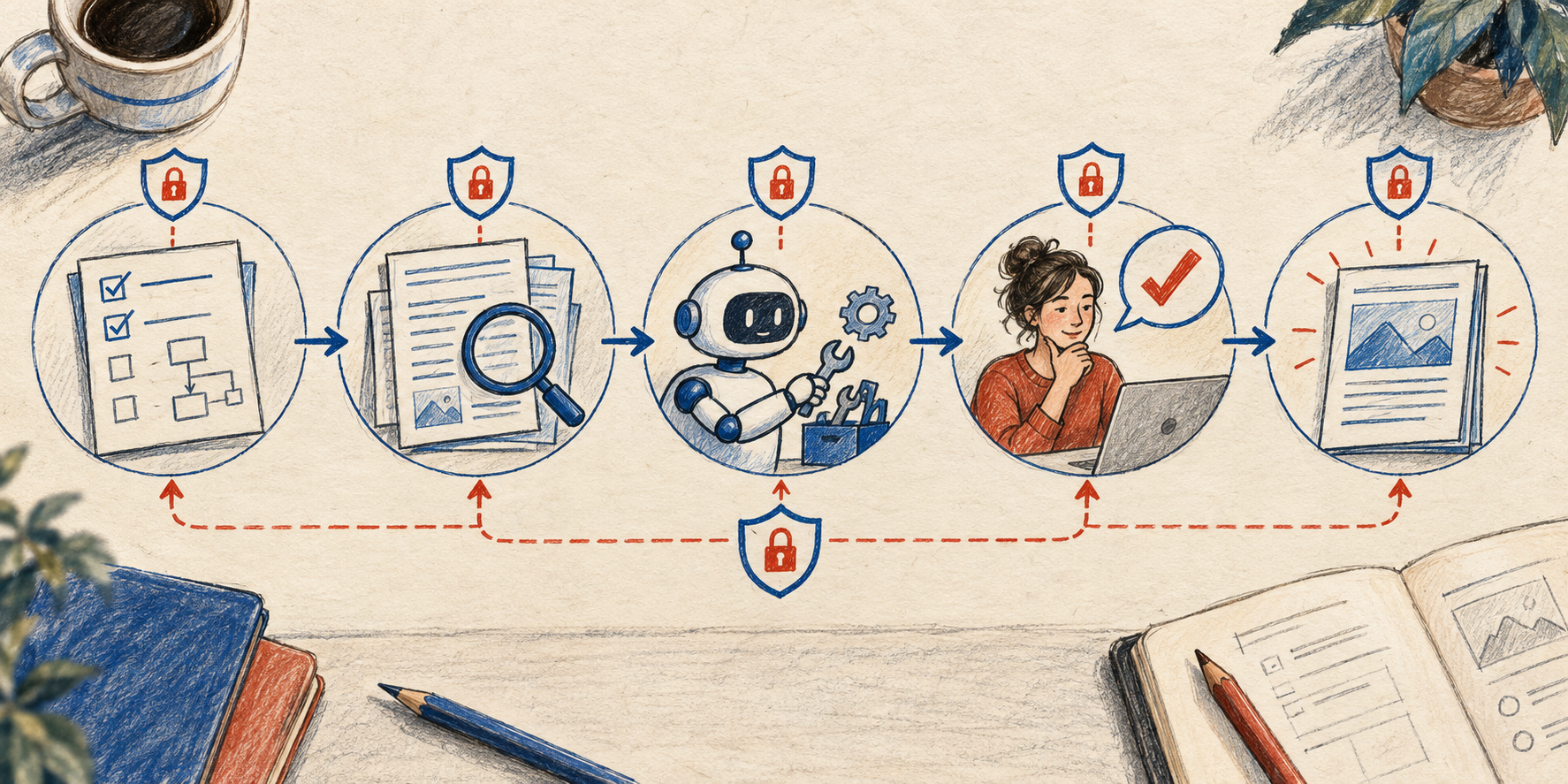
The safest way to use that capability is to separate planning from execution. Let the model inspect context, propose a plan, and request an allowlisted function. Your application should validate the function name, arguments, user scope, data scope, idempotency key, and side effects before anything changes. For irreversible actions, require confirmation or a policy decision outside the model.
An agentic workflow should therefore look like this:
- Observe: collect only the documents, messages, images, and state needed for the task.
- Plan: ask for a structured plan and evidence, not an unbounded chain of actions.
- Propose: return a typed tool call with bounded arguments.
- Validate: check permissions, tenant boundaries, limits, and business rules in application code.
- Execute: run the approved action with an idempotency key and audit record.
- Verify: pass the result back to the model or a deterministic checker for reconciliation.
For routine transformations, use a direct response. For complex repository analysis, multi-step reasoning, or tool selection, test a deeper reasoning setting if the provider exposes one. More reasoning can improve difficult tasks, but it also consumes more tokens and time. The correct default is the cheapest mode that meets your measured quality bar.
How to try Mistral Large 4 today
The fastest path is to run a representative prompt in the Mistral Large 4 Playground. Pick a task that resembles your product, not a toy question. Save the prompt, input files, model ID, reasoning setting, output, latency, and a human assessment. That saved interaction becomes the first row in an evaluation set.
When you move to an API integration, keep the key server-side and confirm the current model identifier in the Mistral Large 4 documentation. A minimal OpenAI-compatible example looks like this:
import os
from openai import OpenAI

client = OpenAI(
    base_url="https://mistrallarge4.com/api/v1",
    api_key=os.environ["MODEL_API_KEY"],
)

response = client.chat.completions.create(
    model="mistral-large-4-0",
    messages=[
        {
            "role": "user",
            "content": "Summarize the incident timeline and list the three strongest pieces of evidence.",
        }
    ],
)

print(response.choices[0].message.content)
Treat this as a starting point, not a production integration. Add timeouts, retries with backoff, request limits, structured logging, output validation, and a clear policy for partial or uncertain answers. Do not place the API key in browser JavaScript, a public notebook, a prompt, or a screenshot.
Preview pricing and open-weight timing
Pricing is time-sensitive because Mistral Large 4 is in public preview. The current Mistral Large 4 pricing page uses account credits for the hosted playground and API, while the model documentation currently displays approximately $0.70 per million input tokens, $0.07 per million cached input tokens, and $2.10 per million output tokens. Treat those figures as a dated reference, not a quote: confirm the price and credit policy that apply to your account before budgeting a production workload.
Do not multiply token price by a theoretical 1M context and call that a project estimate. Real cost depends on how much context you send, how often you repeat it, how much output you allow, caching behavior, retries, and tool calls. A small evaluation script that records input tokens, output tokens, latency, and failure rates will produce a more useful budget than a headline comparison.
Mistral has said that the weights will be released by the end of October. Until that release arrives, the hosted preview is the practical way to test the model. Afterward, teams still need to inspect the license, supported hardware, serving stack, quantization quality, model card, safety guidance, and update policy before claiming that self-hosting is ready.
Open weights can improve control and portability, but they do not remove operational responsibility. Your team would own access control, patching, monitoring, abuse prevention, capacity planning, and incident response. “Open-weight” is a deployment option, not a complete compliance strategy.
Where Le Chonk fits in a real stack
Mistral Large 4 is a strong candidate when at least one of these constraints is central:
- the task combines long documents with reasoning rather than simple retrieval;
- visual evidence is part of the answer;
- the workflow needs structured outputs or controlled tools;
- you want to evaluate an open-weight path for sovereignty or portability;
- the work spans coding, research, documents, or enterprise operations in one model.
It may be the wrong first choice when the task is a short, high-volume classification problem, a deterministic transformation, or a low-latency endpoint where a smaller model already meets the quality bar. A larger model can make a product feel impressive in a demo while making the unit economics and failure modes harder to manage.
Use the site’s Mistral Large 4 comparison page to frame alternatives, then test the same evaluation set across models. Compare answer quality, evidence fidelity, JSON validity, tool safety, long-context recall, image accuracy, p95 latency, cost per successful task, and human correction time.

Production checklist
Before you ship a Mistral Large 4 workflow, check the following:
- Provider contract: pin the base URL, model ID, API version, region, timeout, and retry behavior.
- Secrets: keep API keys in a server-side secret manager and redact them from logs.
- Data boundaries: define what may leave a tenant, region, or internal network; record retention assumptions.
- Context policy: cap input size, remove irrelevant material, preserve source IDs, and leave output headroom.
- Multimodal safety: limit image size and type; test blurry, adversarial, and incomplete images.
- Structured output: validate JSON against a schema and handle refusal, truncation, and missing fields.
- Tool safety: allowlist functions, validate arguments, re-check authorization, and make writes idempotent.
- Evaluation: maintain regression cases for coding, document Q&A, visual grounding, reasoning, and long-context recall.
- Observability: record latency, token usage, failure class, model version, and a redacted request ID.
- Fallbacks: decide what happens on timeout, rate limit, provider outage, or low-confidence output.
For a concrete rollout plan, see the Mistral Large 4 deployment guide. Start with a read-only workflow, measure it, and add writes only after the evidence and authorization path are clear.
Mistral Large 4 FAQ
Is Mistral Large 4 the same as Le Chonk?
Yes. “Le Chonk” is Mistral’s playful official nickname for Mistral Large 4, not a separate model. Use the provider’s documented model ID in code.
How big is Mistral Large 4?
The current model card lists 1.05T total parameters, 52B active parameters, and a 1.6B vision encoder. Mistral’s announcement rounds the total to 1T. Those figures describe architecture, not a promise about API latency or self-hosting hardware.
Does it really support a 1M-token context window?
The model card lists a 1M context window. Actual limits can vary by endpoint, account, request shape, and available output budget. Check the current provider limits and test recall on your own data.
Is Mistral Large 4 open source today?
It is presented as an open-weight model, but the current experience is a hosted public preview. Mistral says the weights will be released by the end of October. Review the final license and deployment documentation before using “open source” as a legal or operational conclusion.
Can I use it for images and documents?
Yes. It is natively multimodal and the model card lists Document QnA among its supported features. Test small text, charts, scans, and visual details that matter to your decision; fluent prose is not proof of visual accuracy.
Should every agent use the largest model?
No. Choose Le Chonk when its long context, visual reasoning, coding, or agentic capabilities improve a measured business outcome. For short, repetitive, high-volume tasks, a smaller model may be faster, cheaper, and easier to control.
Final takeaway
Mistral Large 4, or Le Chonk, is best understood as a large open-weight model in public preview with sparse capacity, native vision, a 1M context window, and a roadmap toward downloadable weights. Its opportunity is not simply “more parameters.” It is the combination of long-context analysis, multimodal evidence, reasoning, coding, tool use, and potential deployment control.
Start with one representative workflow in the Mistral Large 4 Playground, record the result as an evaluation case, and then verify the API contract before building around it. If the model earns its place through measurable accuracy, safe tool behavior, and acceptable cost, Le Chonk can become a serious component in a modern AI stack. If it does not, the same evaluation will tell you exactly which smaller or more specialized model to try next.